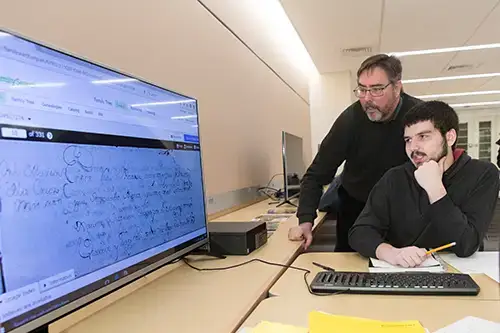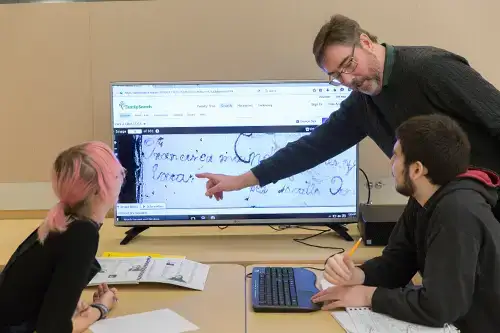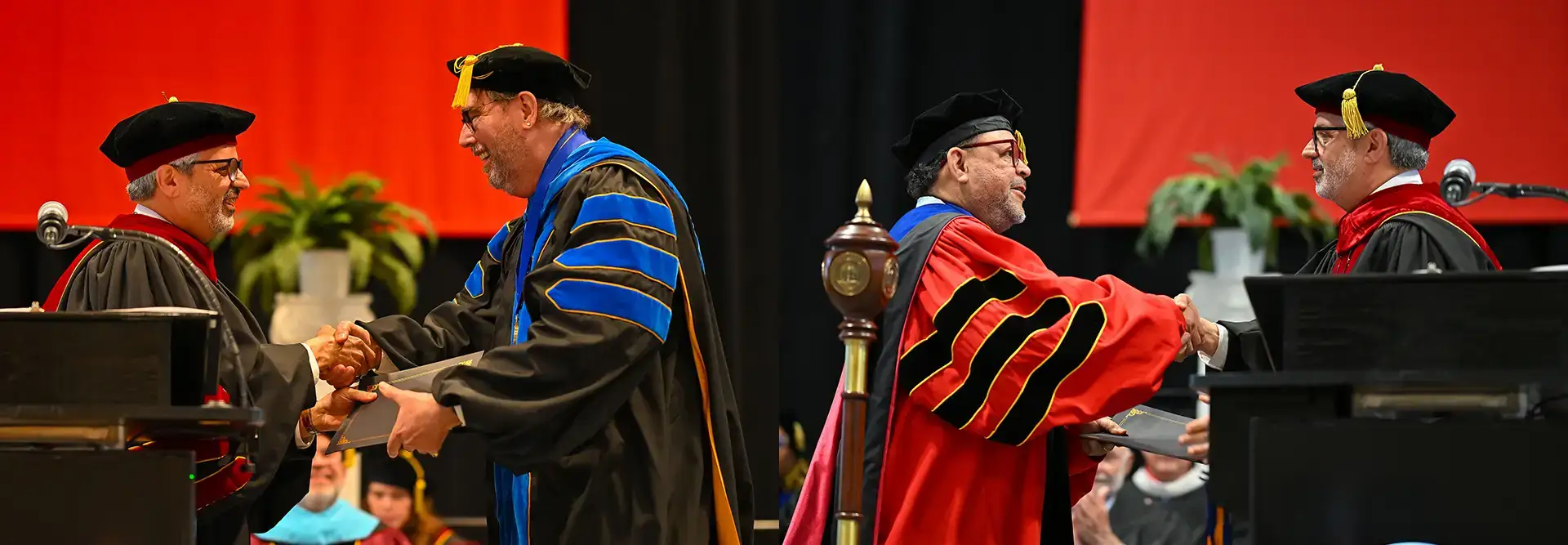
Two SUNY Oneonta professors whose work has reached far beyond the classroom—from advancing international understanding of one of the world’s most celebrated authors to reshaping conversations about Indigenous identity—have earned the highest faculty rank awarded by the State University of New York.
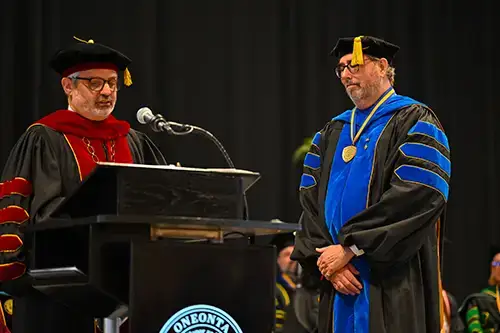
Gustavo Arango, professor of World Languages and Literatures, and Brian Haley, professor of Anthropology, have been named SUNY Distinguished Professors, a designation recognizing faculty who have achieved national or international prominence within their fields.
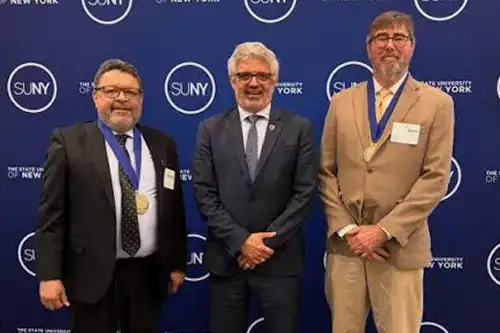
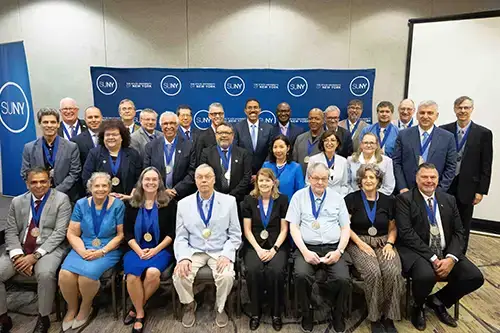
For both, the recognition reflects decades of scholarship and creative work and expertise they bring directly into the classroom.
“Like many Oneonta faculty, Gustavo and I operate from a teacher-scholar model that depends on scholarship to inform teaching, giving our students the chance to be the first to receive new insights,” Haley said.
Scholarship Across Languages and Borders
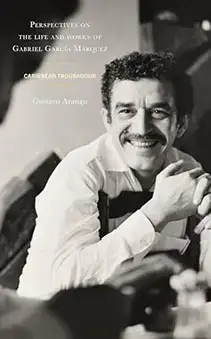
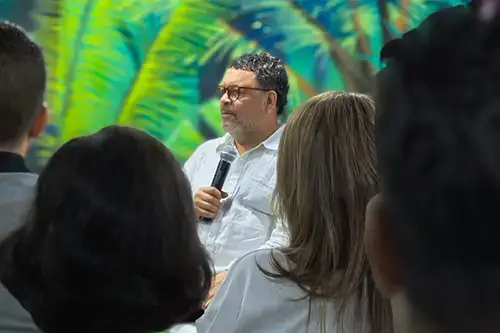
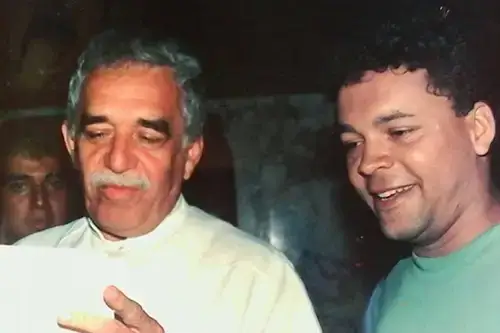
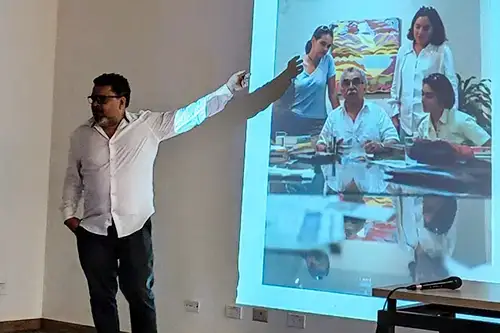
An internationally recognized authority on Nobel Prize-winning Colombian author Gabriel García Márquez, Arango’s investigative and scholarly work contributed to the 2024 publication of García Márquez’s posthumous novel, Until August. Arango has published more than 30 books spanning literary criticism, fiction, translation and journalism.
His distinction also marks two firsts for SUNY Oneonta: Arango is the university’s first Latino faculty member to be named a SUNY Distinguished Professor and its first faculty member to receive the distinction specifically for Scholarship and Creative Work.
Arango has spent 22 of his 32 years in higher education at SUNY Oneonta.
“Receiving this distinction means a great deal to me,” Arango said. “Above all, it carries a feeling of being valued and appreciated—by colleagues who have shaped my thinking over the years, and by students whose curiosity has kept me growing as a teacher. It also gives me a quiet sense of building a legacy: something that extends beyond any one class or semester… Recognition like this is not a resting point but a reminder of why the work matters—it encourages me to keep translating, keep writing, and keep pushing my research further.”
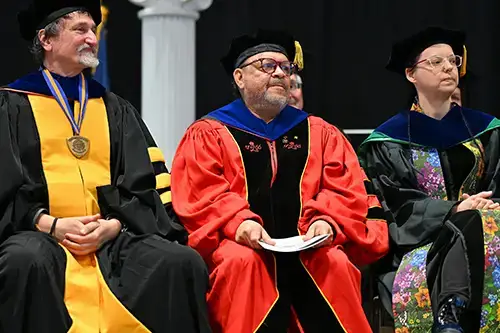
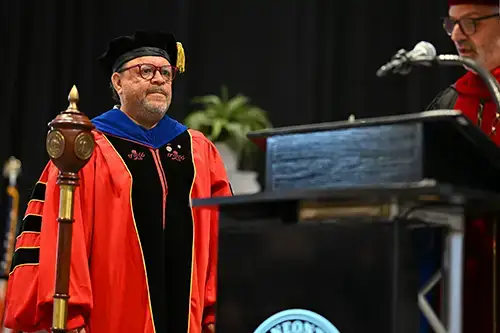
Alumna Rebecca Liloy remembers Arango as an important source of support during her transition from New York City to Oneonta as a new student. Facing culture shock and adjusting to college life, she knew she could count on Arango and felt she had someone in her corner. Years later, he remains a friend and mentor.
“The experience that had the greatest impact on me was reading ‘One Hundred Years of Solitude’ with him as an independent study,” Liloy said. “That remains one of the most meaningful shared reading experiences I have ever had. Reading that book with Profesor Arango helped me understand things about myself, my family, and my culture that I don't think I would have understood the same way on my own.”
Examining Questions of Identity
Anthropologist Brian Haley has spent the past 25 years researching how and why people have claimed Indigenous identities that are not part of their family histories.
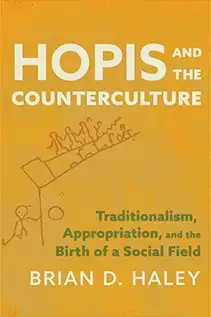
His pioneering work on neo-Indigenism, ethnogenesis and Indigenous identity claims has helped shape scholarship within anthropology. His most recent book, Hopis and the Counterculture: Traditionalism, Appropriation, and the Birth of a Social Field, was published by the University of Arizona Press in 2024.
Haley said pursuing the relatively new and controversial topic came with professional risks, making the recognition particularly meaningful.
“For me, the promotion to SUNY Distinguished Professor is a validation that this was the right thing to do,” Haley said. “It means, as well, that the dozens of younger scholars who have taken up the topic of neo-Indigenism have more legitimacy and their work will be seen as having more value than if they had to forge this path alone.”
Alumna Natalie Benenati, who is now enrolled in SUNY Oneonta’s Cooperstown Graduate Program, remembers Haley as a professor who consistently looked for ways to connect students’ interests with meaningful research opportunities. Knowing Benenati was interested in museum studies and planned to pursue a master’s degree in the field, Haley invited her to serve as his research assistant during her senior year, giving her hands-on experience directly related to her future goals.
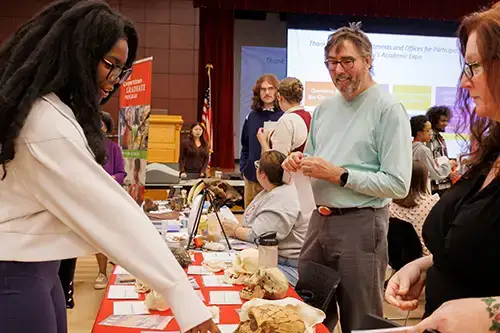
“My task was to create two exhibitions, one in the Anthropology Gallery and the other in the Alden room at the library. I also created a collections database, from scratch, for his current research project,” Benenati said. “Even after graduating, I have continued to work in collaboration with him on the collections database. I am thankful and honored to have worked and continue to work with him. Haley continues to inspire and encourage me to expand my knowledge and experiences thus motivating me to take opportunities that may be out of my comfort zone.”