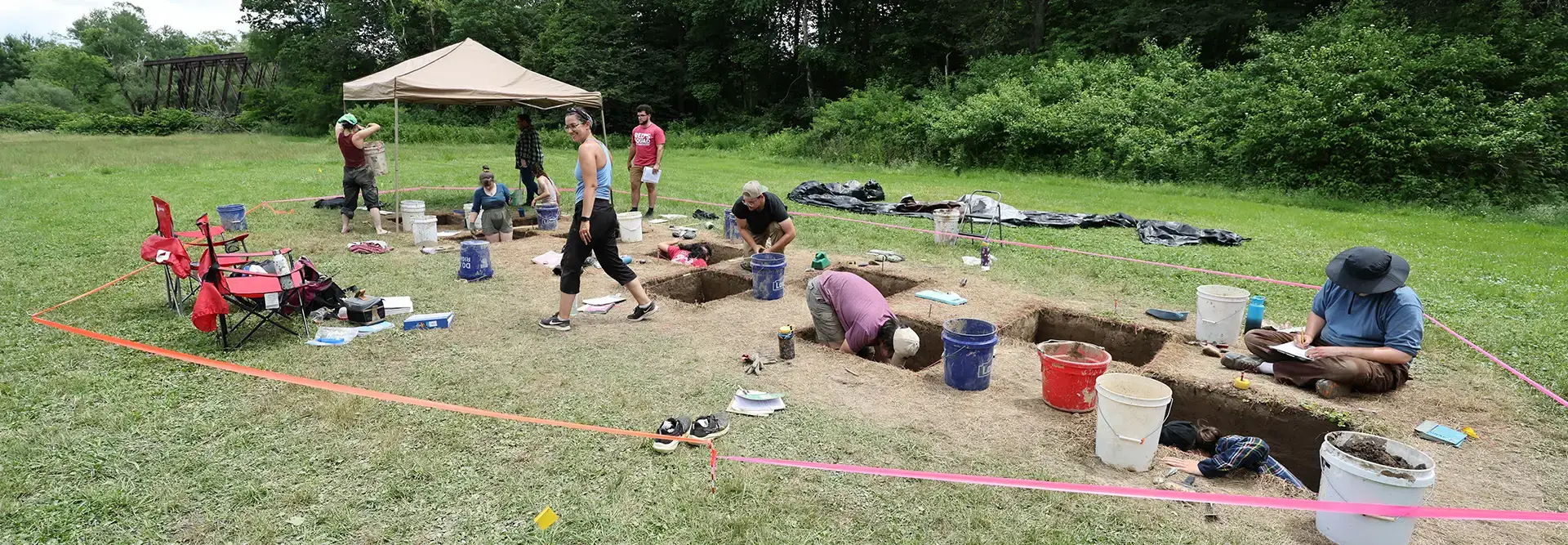
SUNY Oneonta students began their summer digging into the past and honing skills for their future careers during the Pine Lake Archaeological Field School, now in its 12th biennial season.
A collaborative effort between SUNY Oneonta and Hartwick College, the Archaeological Field School introduces students to the basic methods archaeologists use to identify, excavate, record and interpret the history of Native American artifacts found at Pine Lake. Hartwick hosts the field school at its Pine Lake Environment Campus in West Davenport, NY, and SUNY Oneonta provides most of the equipment.
Field school students learn skills that can be applied to all kinds of disciplines. Many are Anthropology majors, but the program is open to all and often attracts students studying history, geoscience, biology, geography, chemistry and other fields. Even if a student isn’t interested in going into archeology, they leave with basic skills applicable for many careers.
A One-of-a-Kind Area Experience
Tucked away in a field nestled between Pine Lake and Charlotte Creek, students worked for eight hours a day sifting through excavated dirt and searching for evidence of ancient hunter-gatherer communities in an area believed to have been a gathering place for Native American people thousands of years ago. Two evenings per week, they complete laboratory analysis of their findings. The school, which ran from May 27 through June 26 and had 21 students total, also enrolled students from other New York universities, such as Adelphi University and St. Lawrence University, and out-of-state students from Pennsylvania, Massachusetts, Connecticut and Wisconsin.
This is the only prehistoric field school in the region, according to SUNY Oneonta Anthropology Professor Renee Whitman, who started the field school in 2003 and co-directs it now. It’s also one of the only field schools where students spend time in the field and in the lab, processing found artifacts, analyzing and completing data entry. Students use the same database system as the New York State Museum to gain an understanding of the curation process.
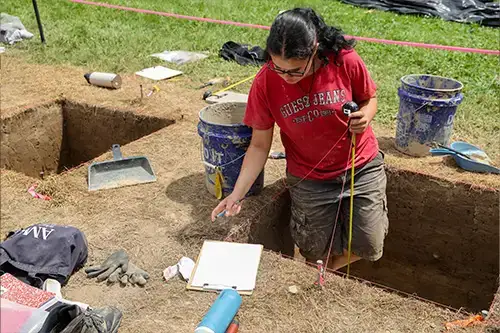
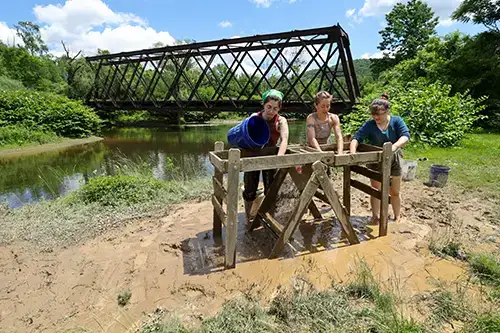
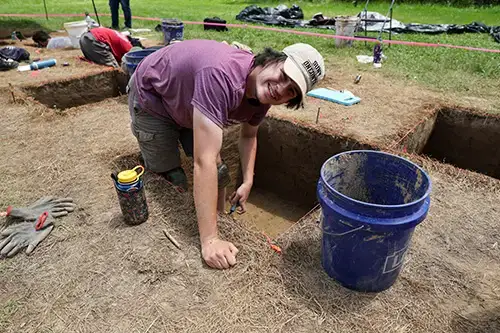
“Our students get a lot of things out of the experience, even if they're not going to become professional archaeologists,” said Whitman. “Whatever field they go into, we can speak to how well they work in a group as well as how well they learn excavation strategies, artifact identification, artifact processing and database entry. It's physically and mentally draining to keep track of all that while you're hot, tired, wet, there's bugs on you. It speaks to their perseverance.”
Over the years, students have found hundreds of artifacts that provide a glimpse into the past, from 4,000-year-old cooking hearths to fire pits, with some artifacts dating back to about 8,000 years ago. Students have found hundreds of flakes of chert (a type of rock used to make tools and weapons), pieces of pottery, nutting stones, a full projectile point (known to most as an arrowhead) and quartz that was not local to the region, indicating that it was traded.
Unearthing Practical Skills and Lifelong Connections
Students begin their excavation by marking out 5-by-5-foot sections of undug land at Pine Lake. Digging 5 to 10 centimeters deep at a time, students collect the dirt and flatten out their excavation site, then record any findings and sift through the dirt they collected for any artifacts. By the end of the field school, students dig as deep as 80 centimeters.
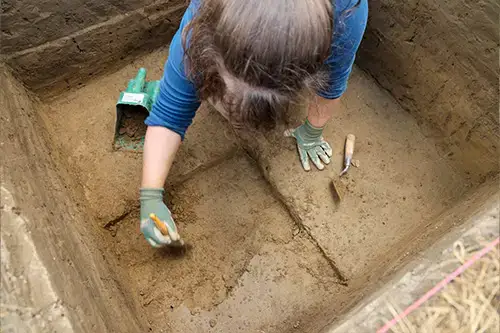
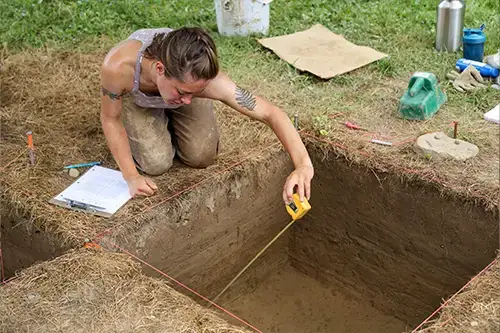
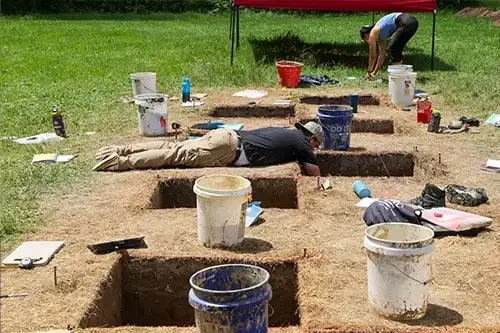
“You learn very practical stuff that’s not necessarily only applicable to archaeology” said Samuel Feldman, a junior and Anthropology major. “You can also take this experience and go into paleontology and other fields that incorporate field and lab work.”
When they’re not in the field or the lab, students cook and have meals together, have the opportunity to fish or kayak, hang out and stay in cabins at Pine Lake. The SUNY Research Foundation provides $500 in grants to the SUNY Oneonta students to help defray the costs of attending the Archaeological Field School.
“If you want to learn how to dig, you know, this is definitely the place to do it,” said Wealthy Robinson, a junior majoring in History and Anthropology. “Even if you're just looking for something to do over the summer and you want to do some archaeology, you want to get into it, this is the perfect place to do it. If you just want to be in nature and off your phone for a few hours a day, this is perfect.”
SUNY Oneonta alumni from various classes returned to the field school throughout the month to assist with the excavation and instruction. Among the returning alumni were Kasey Heiser (’13), who has returned several times since he first attended the field school in 2011, and Natalie Benenati (’25), who attended the field school in 2024 and is now a Museum Studies student in SUNY Oneonta’s Cooperstown Graduate Program.
“It's been an interesting transition for me,” said Benenati. “I've gotten to experience both sides and learning how to teach what I learned like the techniques and context, how to build relationships with people, work with people, especially in this type of setting where you're very close to each other. You learn because you're living together, and then you bring it out into the field and build a community within itself.”
Educating the Future with OWL
Oneonta World of Learning (OWL) children have been visiting the archaeological site almost every season since the field school began in 2003, reflecting how public service is a core part of archaeology. As visitors to the site, OWL students get to see firsthand how archaeology works and get a glimpse of a career that few children are exposed to. During their visit this year, OWL students toured the site, examined artifacts and took part in hands-on activities inspired by those practiced in the past.
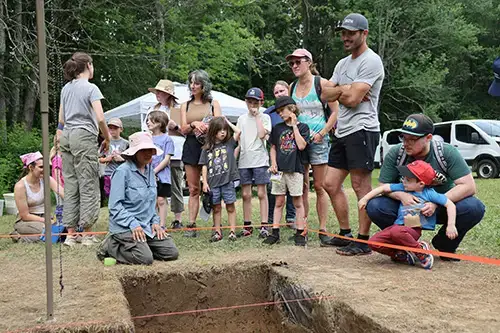
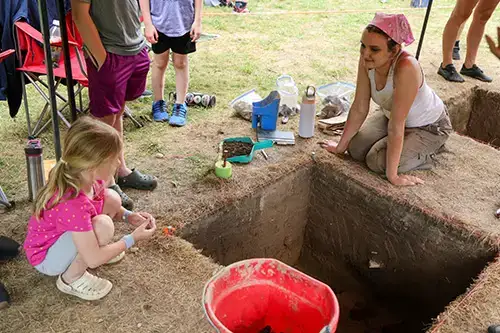
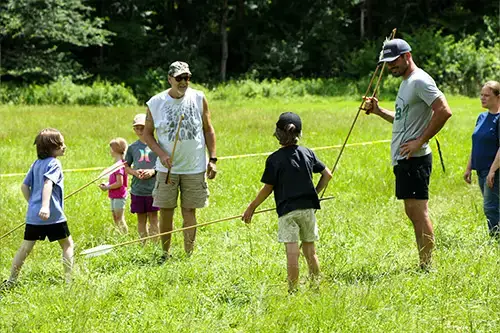
“Site visits introduce them to the field as a possible future path while also teaching them about the people who lived here long ago,” said Whitman. “A key part of that education is helping students understand that Native American communities are not beings of the past—they are very active groups today. Connecting the past to the present is a lot of what we do when we're educating kids.”
SUNY Oneonta students began their summer digging into the past and honing skills for their future careers during the Pine Lake Archaeological Field School.