Learn from faculty who are approachable, involved and highly accomplished in their fields, including two who have been awarded the prestigious SUNY Chancellor’s Award for Excellence in Teaching. Small classes allow for a close rapport between faculty and students, with plenty of opportunities for mentoring and advisement.
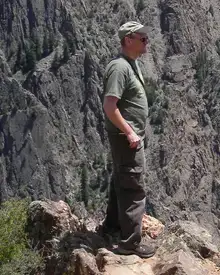
Dr. Keith A. Brunstad
Associate Professor of Mineralogy and Geology
210 Janet R. Perna Science Building
607-436-3066
keith.brunstad@oneonta.edu
Classes taught:
GEOFYRST (GEOL 1000), Introduction to Geology (GEOL 1020), Mineralogy (GEOL 2042), Earth Materials (ESCI 3010), Igneous & Metamorphic Petrology (GEOL 3014), Structural Geology (GEOL 4030), Field Geology of Plate Boundaries (GEOL 4096)
Areas of interest:
Physical Volcanology, Volcano-tectonics, Mineralogy, Petrology, Geochemistry
Research:
Generation, accumulation, transport, and eruption and emplacement processes associated with volcanic systems; regional volcano-tectonic processes associated with plate-boundary environments such as the Cascade volcanic arc and intraplate environments associated with rifts like the Rio Grande of New Mexico and Hot Spots such as Hawaii; use various analytical techniques including XRF, ICP-MS, SEM-EDX, EMPA, and Light Microscopy; environmental impact of reservoir sediment release in the Oneonta Creek drainage basin (Oneonta, NY); aging dams and dam removal in the Northeast, USA.
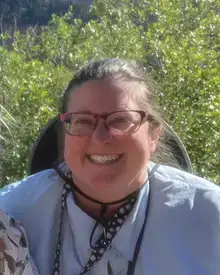
Dr. Leigh M. Fall
Associate Professor of Paleontology and Geology
213 Janet R. Perna Science Building
607-436-2615
leigh.fall@oneonta.edu
Classes taught:
Introduction to the Earth (ESCI 100), Introduction to Oceanography (ESCI 1010), Introduction to Geology (GEOL 1020), Earth History and the Fossil Record (GEOL 2020), Geology of the Rocky Mountain Region (GEOL 3708), Paleontology (GEOL 4021)
Areas of interest:
Paleontology, Paleoecology, Marine Invertebrates, Biodiversity, Body Size, Nitrogen Isotopes, Global Change, Paleoclimatology
Research:
Examining biodiversity within the fossil record; investigating the trophic position (i.e., primary producer, herbivore, carnivore) of the moon snail Neverita duplicata; how body size and abundances of trilobites change along a water depth gradient (shallow to deep) in the Middle Ordovician Trenton Group of Central New York.
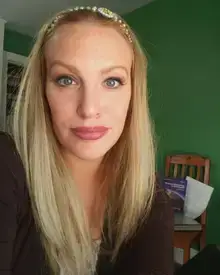
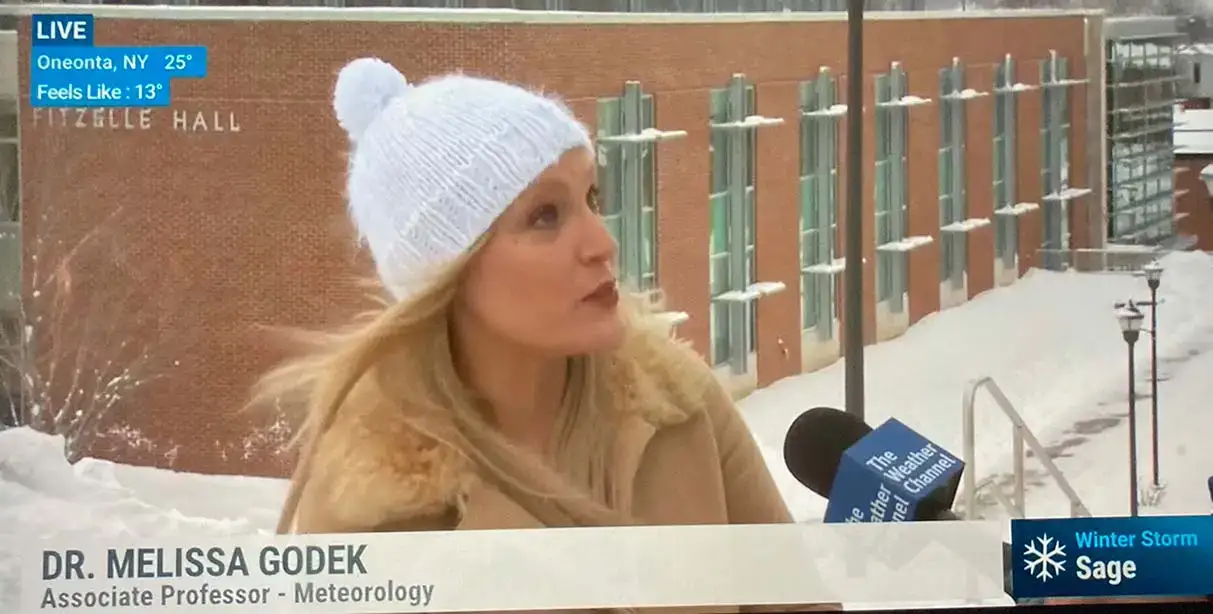
Dr. Melissa Godek
Associate Professor of Meteorology and Climatology, Department Chair
311A Science 1 Building
607-436-3375
Melissa.Godek@oneonta.edu
Classes taught:
Introduction to Climatology (METR 1011), Introduction to Meteorology (METR 1010), Climatology (METR 2012), Atmospheric Dynamics (METR 3050), Research Methods in Dynamics (METR 3051), Advanced Climatology (METR 3086), Mesoscale Meteorology (METR 4075)
Areas of interest:
Climate variability and change, Northeast US climate, winter climatology, dynamics, teleconnection patterns, (El Niño/ Southern Oscillation, North Atlantic Oscillation), air masses, atmospheric singularities, undergraduate research advancement, women in science, communicating scientific research through presentation
Research:
My primary research explores the intraseasonal climate variability that arises with the influence of teleconnection patterns. This allows me to learn about, for instance, how climate oscillation phases like El Niño impact the wide temperature swings that we may get day to day throughout the winter season (all while it may be “warmer than average”). I have also delved into the topic of atmospheric singularities and spent time scientifically validating the existence of events in folklore like the January Thaw and Indian Summer. Most of my time is actually spent with mentoring and co-authoring undergraduate student research. Projects that I have been involved with include examining the specific air masses associated with drought, developing a climatology of winter snow events in the Northeast, exploring how weather can impact MLB game delays and cancellations, and determining vertical atmospheric thickness variations during Albany snow and rain events. Currently two students and I are researching the possibility that hurricane track lengths and phase durations have changed with climate change.
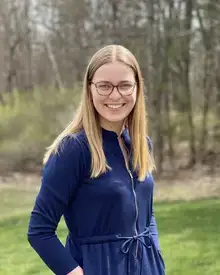
Allison Hannigan
Lecturer in Meteorology
312 Janet R. Perna Science Building
607-436-3322
Allison.Hannigan@oneonta.edu
Classes taught:
Introduction to Oceanography (ESCI 1010), Introduction to Meteorology (METR 1010), Weather Analysis and Forecasting I and II (METR 2060-3061)
Areas of interest:
Data analysis and visualization with python, the effects of a changing climate on extreme weather events, synoptic meteorology.
Research:
My current research utilizes the HYSPLIT model to study atmospheric moisture exchanges and concentrations along the trajectories of air parcels that precede heat wave events at major population centers in the Northeast US. More specifically, I am interested in understanding the dynamics of dry versus humid heat extremes.
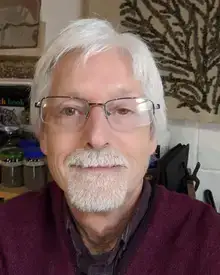
Dr. Les Hasbargen
Associate Professor of Geomorphology and Geology
219 Janet R. Perna Science Building
607-436-2741
Leslie.Hasbargen@oneonta.edu
Classes taught:
Sustaining Water (GEOL 1002), Science of Natural Disasters (GEOL 1015), Introduction to Geology (GEOL 1020), Planetary Geology (GEOL 2050), Geological Data & Analysis (GEOL 2075), Introduction to Hydrogeology (GEOL 282), Geomorphology (GEOL 3070)
Areas of interest:
I am fascinated by Earth and planetary surface processes such as rivers, wind, glaciers, and waves, and the innumerable interactions in the critical zone which encompasses the atmosphere, plants, animals, soils, and groundwater.
Research:
My current research projects focus on 3D object reconstruction using structure-from-motion photogrammetry; shape evolution of alluvium in rivers; controls of turbidity in streams; and remote sensing of landforms and geologic features.
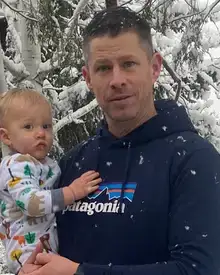
Dr. Scott Maguffin
Assistant Professor of Environmental Geology
214 Janet R. Perna Science Building
607-436-3707
scott.maguffin@oneonta.edu
Classes taught:
Introduction to the Earth (ESCI 1000), Sustaining Waters (GEOL 1002), Introduction to Hydrogeology (GEOL 2082)
Areas of interest:
Hydrogeology, Biogeochemistry, Microbiology
Research:
My research interests lie at the confluence of geology, chemistry, and microbiology. I am interested in the governing principles that dictate water chemistry, the movement of water and chemical species between hydrogeologic reservoirs, and the microbially driven chemical transformations between solid and aqueous phases. My research has focused on the biogeochemistry of groundwater species like iron, nitrate, sulfate, manganese, mercury, and arsenic in groundwater, soil, and agricultural systems. Overall, I am motivated by the need for a greater understanding of the biogeochemical and hydrologic processes governing agricultural and water resources.
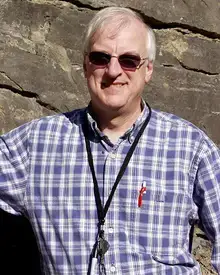
Dr. James Ebert
Distinguished Teaching Professor, emeritus
Areas of interest:
Sedimentology, Stratigraphy, Biostratigraphy, Time Scale Calibration, Carbonate Petrology
Research:
My research is focused on the Early Devonian limestones of New York State. Currently, I am working on a core that penetrates some of these limestones, including a small coral reef. I use microfossils to better constrain the age of various formations. Improved correlation of volcanic ash beds (tephras) within the limestones is underway through the use of gamma ray spectroscopy. Calibration of the Early Devonian portion of the Geologic Time Scale is also in progress, combining microfossil biostratigraphy with U-Pb dating of zircons from tephras and cryptotephras. When I am not living in the Devonian, I am exploring the transition of Lake Erie and Lake Ontario from sand and mud sediments to mixed sand, mud and biogenic sediments produced by invasive quagga mussels.
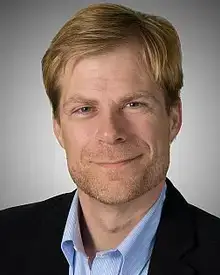
Dr. Devin Castendyk
Adjunct Associate Professor
Dr. Castendyk led the department's Water Resources program from 2005 to 2015 before becoming an environmental consultant in Denver, Colorado. He is now a Senior Geochemist and Project Manager at the global engineering firm Hatch, where he advises the mining industry on strategies to minimize the environmental impact of mining on water quality. Each summer, he continues to teach SUNY Oneonta's international course "Water and the Environment of Guatemala," with Dr. Tracy Allen in the Department of Geography and Environmental Sustainability. He also provides advice to students seeking careers as environmental consultants. Students are invited to contact him with questions at devin.castendyk@hatch.com
Contact the Earth and Atmospheric Sciences Department
209 Janet R. Perna Science Building
108 Ravine Parkway
Oneonta, NY 13820
United States