
Vice President of Equity and Inclusion, Equal Opportunity and Compliance Officer, and Title VI Coordinator
oei@oneonta.edu
(607) 436-2830
The Office of Equity and Inclusion at SUNY Oneonta began in 2006, created as a recommendation to then-President Alan Donovan by the President’s Council on Diversity. Over the years it has adapted to the changing needs of the campus community and is now an umbrella unit for multiple institutional responsibilities that are dedicated to issues of diversity in their broadest sense.
The Office of Equity and Inclusion is led by the Vice President for Equity and Inclusion, Dr. Bernadette Tiapo, a member of the President’s Cabinet, the university's Equal Opportunity and Compliance Officer, and Title VI Coordinator. Dr. Tiapo oversees the Center for Racial Justice and Inclusive Excellence (CRJIE), and Gender and Sexuality Resource Center (GSRC) and Equity and Inclusion Initiatives and Operations.
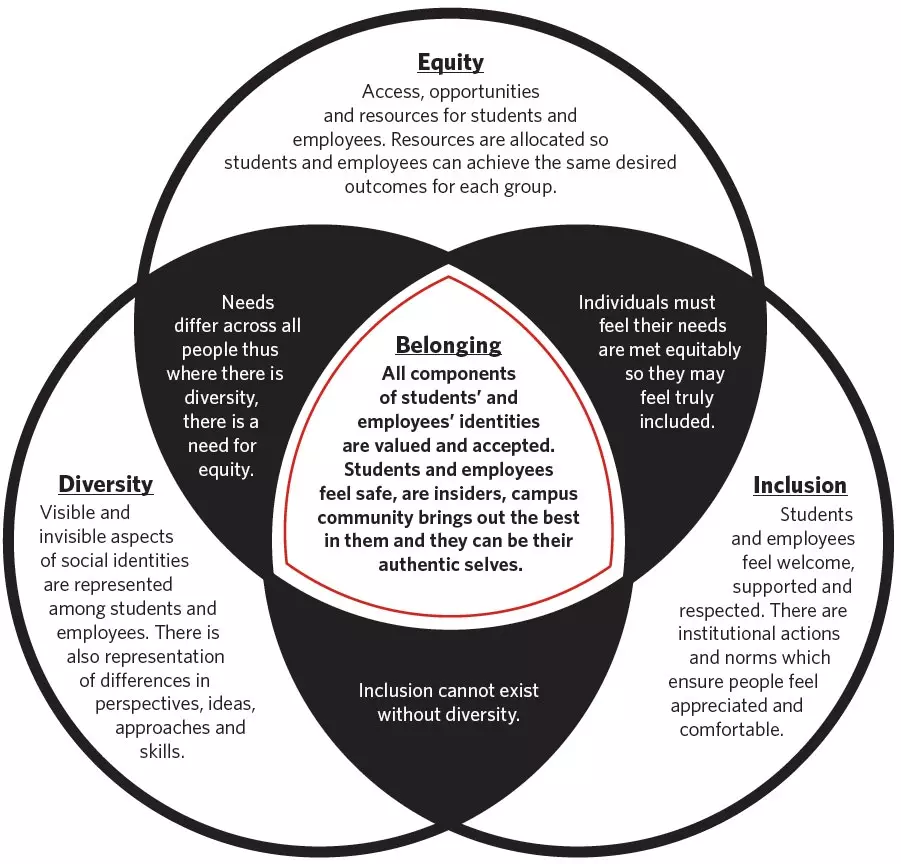
Our hope is to provide advisement, consistency and support for diverse constituents, the whole of the campus community and for our institutional aspirations. Our work supports institutional core values that provide the foundation for all that SUNY Oneonta does, with a particular focus on student engagement and building an inclusive and welcoming community. We accomplish our goals by focusing on the needs of individual diverse community members, on the success of students from diverse communities, and on educating and supporting programming to build an inclusive community.
The Office of Equity and Inclusion is dedicated to supporting the equity, diversity and inclusion endeavors of SUNY Oneonta's academic divisions, administrative departments, and all offices. Important to our mission is our work with both individuals and groups in their efforts to feel included and have voice in shaping our community. We further strive to acknowledge, embrace and affirm a broad vision of diversity that recognizes emergent communities and their needs in our effort to be truly inclusive. The Office accomplishes these ideals through engaging in cross divisional collaborations, participating in and providing professional development opportunities to build consensus and understanding, and working tirelessly to create an inclusive civil working and learning campus community.
SUNY Oneonta values inclusivity. Our greatest strengths come from the people who make up our community and as such are empowered to create a meaningful impact within our campus and globally. We foster a culture that is inclusive, and support the individual expression of differing perspectives, ideas, and experiences so that students can grow intellectually, thrive socially, and live purposefully.
Institutions of higher education have the power to redress inequities and stratifications in our society. SUNY Oneonta embraces this power as opportunity and provides equitable access to affordable, transformative educational opportunities. We promote and support living and working in a diverse, equitable learning-centered community. SUNY Oneonta values all members of our community whose sense of belonging and ability to learn, thrive, and achieve are the measure of our collective success.
We acknowledge with respect the Kanienʼkehá:ka—the People of the Land of Flint—also known as the Mohawk Nation, on whose lands SUNY Oneonta now stands. The Mohawks are the Keepers of the Eastern Door of the Haudenosaunee—the People of the Longhouse—an indigenous confederacy that includes the Oneida, Onondaga, Cayuga, Seneca, and Tuscarora Nations. They and their relatives in the United States and Canada maintain stewardship of this land today.
This statement was developed in consultation with Darren Bonaparte, Director, Tribal Historic Preservation Office, St. Regis Mohawk Tribe.
Endorsed by University Senate, Spring 2024
SUNY Oneonta is committed to maintaining a learning and workplace environment free from Sexual Harassment and unlawful Discrimination. In its continuing effort to seek equity in education and employment, and in support of Federal and State anti-discrimination legislation, SUNY Oneonta has adopted this complaint procedure for the prompt and equitable investigation and resolution of allegations of unlawful discrimination on the basis of age, race, creed, color, ethnicity, national origin including shared ancestry and/or ethnic characteristics, religion, sexual orientation, gender identity or expression, military or veteran status, sex, disability, predisposing genetic characteristics, familial status, marital status, domestic violence victim status, criminal conviction, arrest record, citizenship or immigration status, gender, pregnancy, pregnancy outcomes, reproductive healthcare and autonomy, or any other characteristic protected by applicable state or federal law. Harassment on the basis of the above protected categories is one form of unlawful Discrimination.
SUNY Oneonta will take steps to prevent Discrimination and Harassment, to prevent their recurrence, and to remedy their discriminatory effects on the victim(s) and others, if appropriate. Sex discrimination includes Sexual Harassment and sexual and interpersonal violence. Depending on whether the alleged conduct meets the definition found at 34 C.F.R. § 106.30 and the affiliation of the Respondent, it may be addressed under this Procedure or the applicable Campus’s Student Title IX of the Education Amendments of 1972 (“Title IX”) Grievance Procedure. Retaliation against a person who files a complaint, serves as a witness, or assists or participates in any manner in this Procedure is strictly prohibited and may result in disciplinary or other appropriate action.
Religious Holidays
Education Law (Section 224-a) states that any student who is unable, because of their religious beliefs, to attend classes on a particular day or days shall be excused from any examinations, study or work requirements.
Similarly, under New York State law, SUNY Oneonta is obligated to provide an equivalent opportunity for faculty to be absent from classes for religious observance. In such cases, faculty may notify students of alternate class arrangements, assignments, or cancellation. Such absences may not result in additional class sessions scheduled outside the existing time pattern for the course.
March
- March 4 – Hindu: Holi
- The festival of colors, celebrating the arrival of spring. This is one of the most known Hinduism holy days.
- March 4 – Sikh: Hola Mohalla
- A Sikh festival featuring martial arts, poetry, and community gatherings.
- March 21 – Baha’i: Naw-Ruz*
- The Baha’i New Year, celebrated with joy and festivities.
- March 21 – Islamic: Eid al-Fitr*
- Marks the end of Ramadan, celebrated with a feast and prayers. On one of the most important Islamic holy days.
- March 31 – Jain: Mahavir Jayanti
- Celebrates the birth of Lord Mahavira, the founder of Jainism.
April
- April 2 – Jehovah’s Witnesses: The Memorial of Jesus’ Death
- Commemorates the death of Jesus Christ.
- April 2-9 – Jewish: Passover*
- Celebrates the liberation of the Israelites from Egyptian slavery.
- April 5 – Christian: Easter
- Celebrates the resurrection of Jesus Christ.
- April 14 – Sikh, Hindu: Vaisakhi
- Marks the Sikh New Year and celebrates the spring harvest.
May
- May 1 – Pagan and Wiccan: Beltane*
- Celebrates the peak of spring and the coming of summer.
- May 1 – Buddhist: Vesak
- Commemorates the birth, enlightenment, and death of Buddha.
- May 5 – Jewish: Lag BaOmer*
- A festive day marking the end of a plague during Rabbi Akiva’s lifetime.
- May 24 – Buddhist: Buddha’s Birthday
- Celebrates the birth of Siddhartha Gautama, the founder of Buddhism.
- May 27 – Islamic: Eid-al-Adha*
- Commemorates the willingness of Ibrahim to sacrifice his son.
- May 29 – Baha’i: Ascension of Baha’u’llah*
- Commemorates the passing of Baha’u’llah, the founder of the Baha’i Faith.
June
- June 4 – Roman Catholic: Feast of Corpus Christi
- Celebrates the Eucharist, the body and blood of Jesus Christ.
- June 17 – Islamic: New Year*
- Marks the new Islamic lunar calendar year.
- June 21 – Pagan and Wiccan: Litha*
- Marks the longest day and shortest night of the year.
July
- July 10 – Baha’i: Martyrdom of the Bab*
- Commemorates the execution of the Baha’i co-founder.
- July 23 – Rastafarian: Birthday of Haile Selassie*
- Celebrates the birth of the Ethiopian Emperor, revered in Rastafarianism.
- July 24 – Church of Jesus Christ of Latter-day Saints: Pioneer Day
- Commemorates the arrival of the first Mormon pioneers in Utah.
August
- August 1 – Pagan and Wiccan: Lughnasadh*
- Celebrates the beginning of the harvest season.
- August 15 – Roman Catholic: Feast of the Assumption
- Celebrates the assumption of the Virgin Mary into heaven.
September
- September 11 – Coptic Orthodox Christian: Nayrouz
- Marks the start of the Coptic New Year.
- September 14 – Hindu: Ganesh Chaturthi
- Celebrates the birth of Lord Ganesh.
- September 23 – Pagan and Wiccan: Mabon*
- Celebrates the autumn equinox and the second harvest.
- September 12-13 – Jewish: Rosh Hashanah*
- The Jewish New Year, a time of reflection and renewal.
- September 21 – Jewish: Yom Kippur*
- The holiest day in Judaism, dedicated to atonement and repentance. This is one of the most important Jewish high holy days.
October
- October 17-21 – Hindu: Durga Puja
- Celebrates the goddess Durga’s victory over the buffalo demon Mahishasur
- October 31 – Pagan and Wiccan: Samhain*
- Celebrates the end of the harvest and the beginning of winter.
November
- November 1 – Christian: All Saints’ Day
- Honors all saints, known and unknown.
- November 2 – Christian: All Souls’ Day
- Commemorates all the faithful departed.
- November 8 – Hindu: Diwali
- The festival of lights, celebrating the victory of light over darkness.
- November 10 – Baha’i: Birthday of the Bab*
- Celebrates the birth of the Baha’i co-founder.
- November 24 – Sikh: Martyrdom of Guru Tegh Bahadur Sahib
- Honors the martyrdom of the ninth Sikh Guru.
- November 29 – Christian: Advent
- Marks the beginning of the Christian liturgical year leading up to Christmas.
December
- December 4 – Eastern Orthodox Christian: The Entrance of the Theotokos into the Temple
- Celebrates the presentation of Mary in the temple.
- December 6 – Christian: Saint Nicholas Day
- Celebrates Saint Nicholas, the patron saint of children.
- December 8 – Buddhist: Bodhi Day
- Commemorates the enlightenment of Buddha.
- December 5-12 – Jewish: Hanukkah*
- The Festival of Lights, celebrating the rededication of the Second Temple.
- December 21 – Pagan and Wiccan: Yule*
- Celebrates the winter solstice and the rebirth of the sun.
- December 25 – Christian: Christmas
- Celebrates the birth of Jesus Christ.